India's First BIS 18256 Certified GFRP Rebar Range


India's First BIS 18256 Certified GFRP Rebar Range

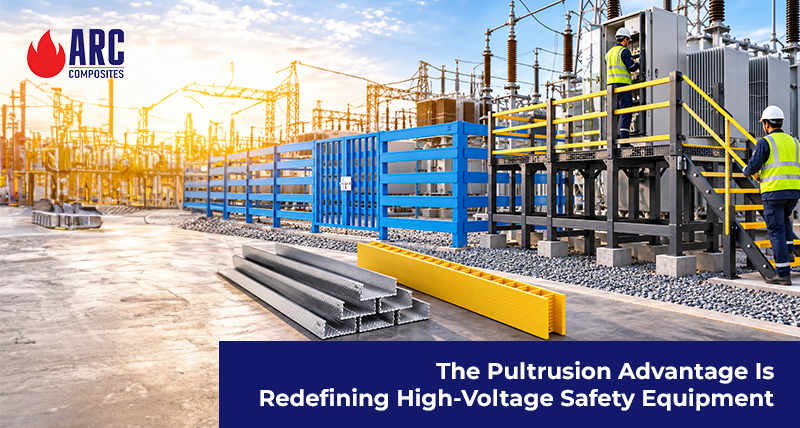
Most people never think about how safety equipment gets made. They just trust that a ladder, a handrail, or a discharge rod will hold up when it matters most. That trust breaks down fast when equipment fails on the job, and in high-voltage environments, failure is rarely a minor inconvenience. It can mean an electric shock, a structural collapse, or a piece of gear that simply gives up long before its rated lifespan ends.
Behind almost every reliable piece of composite safety gear sits one manufacturing process doing the heavy lifting. The global pultrusion market crossed roughly USD 2.55 billion in 2025 and continues climbing, driven largely by industries that cannot afford material failure. If you specify, purchase, or work with an FRP pultruded profile on a regular basis, understanding why this process outperforms older manufacturing methods will change how you evaluate every safety product on your shelf.
Stick around, because this gets genuinely interesting.
Pultrusion pulls continuous fiber strands through a resin bath and then through a heated die that shapes and cures the material in one continuous motion. Unlike molding processes that shape material in batches, pultrusion runs constantly, producing long, uniform profiles with consistent cross sections from the first metre to the last.
This continuous nature is exactly what makes an FRP pultruded profile so dependable. Every inch of the profile receives the same fiber alignment, the same resin saturation, and the same curing temperature. There is no guessing about whether one section performs differently from another, because the process itself removes that variability almost entirely.
Traditional composite manufacturing sometimes chops fibers into shorter lengths before molding, which weakens the final structure at every fiber break point. Pultrusion keeps fibers continuous along the entire length of the profile. This single difference gives pultruded products dramatically higher tensile strength along their length compared to short-fiber alternatives, which explains why structural profiles, ladder rails, and discharge rods all rely on this exact manufacturing approach.
Why does dimensional consistency matter so much in safety equipment? A discharge rod that measures slightly differently from batch to batch might still pass a spot check, but inconsistent wall thickness or fiber density creates weak points that inspectors cannot always catch visually.
Pultrusion solves this through precise die control. The die determines the final shape and thickness of the profile, and because material passes through the same die continuously, dimensional tolerances stay remarkably tight across an entire production run. Engineers specifying safety equipment can trust that a rod, rail, or bracket manufactured today will match one manufactured six months from now, down to fractions of a millimeter.
This consistency becomes critical when equipment needs to interlock with other components, such as earthing clamps attaching to a discharge rod or handrail sections joining across a walkway. Mismatched dimensions create gaps, loose fittings, and stress points that eventually lead to premature failure, so the precision pultrusion delivers protects both safety and long-term serviceability.
Steel has always been strong, but it comes with a serious weight penalty. Can lightweight composite profiles really match steel’s structural performance? For most high-voltage safety applications, the answer is yes, and often with better performance per kilogram carried.
An FRP pultruded profile delivers a strength-to-weight ratio that frequently outperforms aluminum and rivals steel in specific load conditions, all while weighing a fraction of what metal alternatives weigh. Field crews installing cable trays, ladder systems, or structural supports benefit directly from this weight reduction, since lighter components mean faster installation, reduced crane or lifting requirements, and less physical strain during manual handling.
Utility crews frequently install equipment in elevated positions, confined switchyard spaces, or hard-to-reach transmission structures. Carrying lighter pultruded components up a ladder or through a tight access point reduces both installation time and injury risk. Heavier metal components often require additional rigging or multiple workers, while pultruded profiles can frequently be handled by a single technician safely.
Metal conducts electricity, and in high-voltage environments, that property turns structural components into potential hazards. Pultruded profiles built from fiberglass reinforcement and specialized resin systems remain fundamentally non-conductive, making them safe to use in and around energized equipment without the grounding precautions metal structures require.
This insulating property extends across the entire pultruded product family, not just discharge rods. Cable trays supporting live wiring, structural supports near switchgear, and fencing around
substations all benefit from a material that will not create an unintended electrical path. What makes FRP profiles suitable for electrical substations specifically? Their combination of high dielectric strength and resistance to surface tracking allows them to sit safely near energized components year after year, even in outdoor, weather-exposed installations.
Resin formulation plays a major role here too. Manufacturers select fire-retardant and electrically stable resin systems specifically for utility applications, ensuring the profile maintains its insulating properties even under thermal stress or prolonged UV exposure common in outdoor substation environments.
Substations and industrial facilities expose equipment to relentless environmental stress. Rain, humidity, salt air, and chemical exposure all attack metal structures over time, leading to rust, pitting, and eventual structural failure. Pultruded FRP profiles simply do not corrode the way steel or even coated aluminum eventually does.
This corrosion resistance directly reduces lifecycle costs. Facilities replace or repaint metal handrails, ladders, and structural supports on a recurring maintenance schedule, while pultruded alternatives often run for decades with minimal intervention beyond routine inspection. Coastal power plants and chemical processing facilities increasingly specify pultruded profiles specifically because the total cost of ownership beats metal once maintenance and replacement cycles enter the calculation.
Market research backs this trend clearly, with infrastructure modernization and corrosion-resistant material demand cited as leading growth drivers behind the expanding global pultrusion products market, which industry analysts value at roughly USD 3.9 billion in 2026 and expect to keep climbing through the next decade.
Discharge rods represent just one application within a much broader pultruded product ecosystem. What other safety equipment gets manufactured through pultrusion? Structural profiles, ladders, handrails, fencing, and cable trays all rely on the same core manufacturing advantages that make discharge rods reliable.
Structural profiles serve as load-bearing supports in walkways, platforms, and equipment housings, offering the same corrosion resistance and insulation properties utilities need throughout a facility, not just at the point of live equipment contact. Ladders manufactured through pultrusion provide non-conductive climbing access near energized systems, eliminating a hazard that traditional metal ladders present near overhead lines.
Handrails installed around elevated platforms need to resist both mechanical impact and long-term weather exposure, and pultruded profiles handle both demands without the rust streaks or structural fatigue metal handrails eventually show. Fencing around substation perimeters benefits from the same non-conductive, corrosion-resistant properties, adding a layer of protection against accidental contact. Cable trays supporting power and control wiring gain mechanical support and fire-resistant properties without introducing conductive pathways near live circuits.
Regional demand patterns reveal exactly where this technology is headed next. Asia Pacific held the largest share of the global pultrusion market in 2025, supported by expanding wind energy supply chains, coastal and industrial infrastructure development, and rapid scale-up of regional composite manufacturing capacity. India specifically continues gaining momentum in electric utility upgrades, positioning the country as an increasingly important consumer of pultruded FRP products across power generation, transmission, and distribution infrastructure.
This regional growth reflects a broader industrial reality. As power networks expand to meet rising demand, utilities need materials that scale reliably across thousands of installation points without introducing corrosion, weight, or insulation compromises. Pultrusion answers that need directly, which explains why manufacturing capacity continues expanding across the region rather than slowing down.
Pultrusion has quietly become one of the most important manufacturing processes behind reliable high-voltage safety equipment. Continuous reinforcement delivers strength that short fiber processes cannot match. Dimensional consistency protects safety margins across every batch produced.
A superior strength-to-weight ratio makes installation faster and safer for field crews. Electrical insulation and corrosion resistance together extend service life while keeping technicians safe around energized equipment. The FRP pultruded profile you see in a discharge rod today shares its manufacturing DNA with ladders, handrails, fencing, cable trays, and structural supports across the same facility, proving that this single process underpins an entire ecosystem of dependable safety infrastructure.
As global demand keeps climbing, choosing pultruded components over outdated alternatives is quickly becoming less of a preference and more of an industry standard.
If your facility still relies on metal components that rust, sag, or require constant maintenance, it may be time to rethink your material strategy. ARC Composites manufactures FRP pultruded profiles engineered for the demanding realities of high-voltage infrastructure, from structural supports to ladders, handrails, fencing, and cable trays.
Every profile delivers consistent dimensions, dependable insulation, and long-term corrosion resistance your team can count on. Contact ARC Composites today, discuss your project requirements, and upgrade your infrastructure with pultruded FRP products built to outperform traditional materials for decades to come.
Power utilities, chemical plants, water treatment facilities, and coastal infrastructure projects rely heavily on pultruded profiles due to their corrosion resistance and electrical insulation.
Well-manufactured pultruded profiles often last several decades with minimal maintenance, significantly outperforming coated steel alternatives exposed to similar environmental conditions.
Initial costs can run higher, but lifecycle costs typically favour pultruded profiles once reduced maintenance, corrosion prevention, and replacement savings get factored into the comparison.
Yes, manufacturers design custom dies to produce specific cross sections, allowing pultruded profiles to match precise structural, dimensional, and load-bearing requirements for individual projects.
Expanding wind energy infrastructure, coastal industrial development, and growing electric utility upgrades across India and neighbouring countries are driving strong regional pultrusion demand.
Have you ever noticed why some buildings stay strong for decades, while others start showing cracks within a few years? The reason is not always visible from the outside. It lies in what holds the building together—what we call structural profiles. Today, construction is not just about using more concrete or steel. It is about […]