India's First BIS 18256 Certified GFRP Rebar Range


India's First BIS 18256 Certified GFRP Rebar Range

Have you ever noticed why some buildings stay strong for decades, while others start showing cracks within a few years?
The reason is not always visible from the outside. It lies in what holds the building together—what we call structural profiles.
Today, construction is not just about using more concrete or steel. It is about making smarter choices. One such choice is using FRP structural profiles, which not only make a building stronger and less prone to damage but also make sure that it is in good condition, even in harsh conditions.
In this blog, we’ll explore how the right structural profile strengthens a building over time and why this decision plays a bigger role in modern construction today.
A structural profile is an arrangement of load-bearing components used to form a building’s structural framework. This includes columns, beams, slabs, floors, joints, and framing sections that are specifically designed to transfer loads safely from the structure to the foundation.
These components work together to manage dead loads, live loads, wind forces, and long-term stresses that affect the structural integrity of a building throughout its life.
Structural strength is not achieved by increasing material thickness. It depends on selecting the right profile shape and material—ones that provide:
When designed and executed correctly, a structural profile becomes the primary shield against cracking, deformation, and premature structural failure.
When a building’s structural design is weak, problems do not appear overnight. They show up slowly. At first, they may seem minor, but over time they become serious and expensive. Some of the most common warning signs include:
As these issues grow, maintenance costs increase. Repairs become frequent, and temporary fixes stop working. Most importantly, the safety of the building is at stake.
This is why many builders and developers are now focusing on strong structural planning from the start. By using advanced materials like FRP and GRP, they reduce the risk of early damage and create structures that remain safe and reliable for lifetime.
Fiberglass-Reinforced Plastic (FRP), also known as Glass-Reinforced Plastic (GRP), is now widely used in modern construction. It has become a popular substitute for traditional structural materials. Why? It is because it has a lightweight design and durability.
FRP structural profiles are made using a process called pultrusion. In this process, glass fibres are passed through resin and shaped using heat. This process helps in the production of multiple varieties of structural profiles. The end-product which is obtained is not only tough but also resistant to corrosion, moisture, chemicals, and even UV degradation.
FRP structural profiles are not chosen just because they are new or different. They are chosen because they solve problems that traditional materials struggle with over time. Let us see how.
One of the biggest reasons buildings weaken over time is corrosion. Steel begins to rust when exposed to moisture, chemicals, or salty air. Once corrosion starts, it slowly eats into the structure and reduces its strength.
FRP does not rust. This makes it highly suitable for coastal buildings, chemical plants, water treatment facilities, and industrial environments where moisture and chemicals are always present.
FRP offers strength comparable to steel but at a much lower weight. This combination is important in modern construction. This material exerts less load on foundations, reducing stress on the entire building.
And as FRP is easier to handle and install, construction time is also reduced. There are lesser complications during installation and the structural performance of the building is never compromised.
Water is one of the main causes of structural damage. Many materials absorb moisture, which leads to swelling, weakening, or internal damage over time.
FRP pipes and structural profiles do not absorb water. They maintain their shape and strength even in underground installations, basements, cooling towers, and high-humidity areas. This makes them a reliable choice where moisture exposure is unavoidable.
At ARC Insulation and Insulators Ltd., we have seen how the right structural materials can change the performance of a building over time. That is why we recommend FRP structural profiles for both new construction and strengthening existing structures.
Such profiles not only possess high strength but also extreme resistance to corrosion, moisture, and wear, which is exactly what modern infrastructure needs. We focus on providing materials that support long-term performance, not just short-term construction timelines.
Ans. FRP material typically has a lifespan of 30 to 50 years or more, depending on design, application, and environmental conditions. Since FRP does not rust, rot, or corrode, it often lasts longer than traditional materials in harsh or moisture-prone environments.
Ans. No, FRP does not break easily when designed and installed correctly. It has high tensile strength and good impact resistance. Unlike brittle materials, FRP can absorb stress without cracking, which makes it reliable for structural and industrial applications.
Ans.Yes, FRP is termite proof. Since FRP is made from fiberglass and resin, it does not contain any organic material that attracts termites. This makes it a reliable option in areas where termite damage is a concern.
Ans. Yes, a new FRP layer or profile can be installed over an existing FRP surface in many cases. This is possible only if the old FRP is still in good condition and has no major cracks, damage. Also make sure to clean the surface for a better grip.
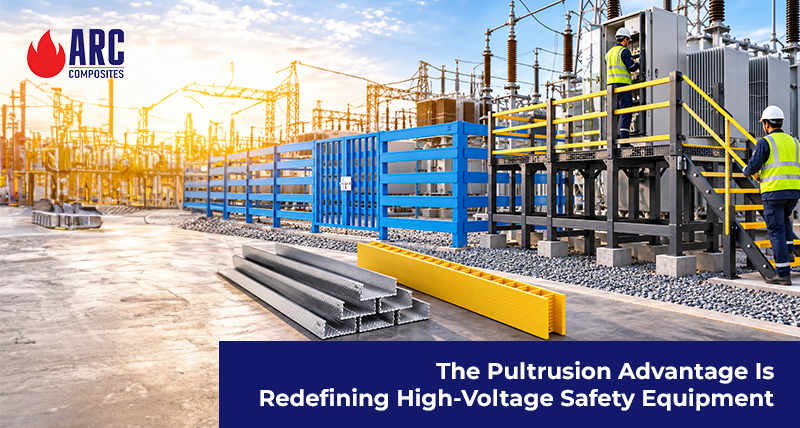
Most people never think about how safety equipment gets made. They just trust that a ladder, a handrail, or a discharge rod will hold up when it matters most. That trust breaks down fast when equipment fails on the job, and in high-voltage environments, failure is rarely a minor inconvenience. It can mean an electric […]