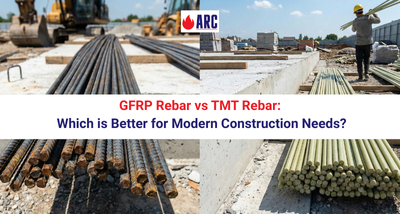
Strength and durability are the pillars of modern construction. The larger projects need the necessary strength to withstand the external force. When building structures, like a crash barrier, underground tank, boundary wall, grade slab, partition wall, reinforced bars or rebars are valuable. In India, both TMT (Thermo-Mechanically Treated) bars and GFRP (glass fiber reinforced polymer) rebars are available.
While TMT bars are a favorite choice for their excellent strength and ductility, GFRP bars have also gained popularity in recent years. So, which one is a better choice more tailored for the modern construction needed?
Whether you are a veteran or a newbie looking into reliable construction material, this article will help you make a better decision:
The manufacturing process of TMT bars involves a combination of thermal and mechanical processes. The steel rods are rapidly heated and then cooled several times to create hardened other layers with a soft core.
TMT bars are easily available across India which makes them compatible with most existing construction processes. However, one thing that construction projects suffer the most from using TMT bars is rusting. The bars are weak to moisture, air, and aggressive environments, which lead to corrosion, reducing their structural integrity.
GFRP rebars are made from high-strength glass fibers held together in a polymer resin matrix. This is an excellent choice for areas with high moisture content.
Below, we have mentioned the differences between the two rebars:
At a glance, GFRP seems like a better choice. Especially if you consider corrosion resistance and long-term durability. But TMT remains a solid choice for short-to-medium-term use where you don’t have to worry about rusting.
GFRP rebars being lightweight are easier to handle and install, which improves construction efficiency and reduces the risk of errors. ARC GFRP rebars are non-magnetic and free of ions, making them ideal for reinforcement in environments sensitive to electromagnetic interference, such as:
TMT bars have been the first choice for years in the Indian construction industry. However, with time, builders and constructors have found some issues that can impact structural integrity. GFRP rebars are an ideal choice to avoid such drawbacks. These rebars are affordable and can increase the lifespan of a structure like boundary walls, roads, foundations, and tanks.
Yes, GFRP rebars are stronger than TMT bars. They have up to twice the tensile strength of steel bars, which helps to withstand high-stress environments like coastal or chemical zones.
While GFRP bars are ideal for moisture-prone or corrosive environments, they may not be ideal under high pressure.
GFRP is actually a cost-effective solution in the construction sector with lower installation and maintenance costs.
GFRP rebars can last 80–100 years without corrosion, whereas TMT bars may degrade over time, especially in moisture-laden environments.
GFRP rebars are getting increasingly popular. The exclusive properties of these rebars are making them popular for foundation, precast, retaining wall, concrete road, drains and so on. However, you can’t just pick any supplier, you need the best GFRP rebar manufacturers in India for a peace of mind. In this article, we explore why picking […]
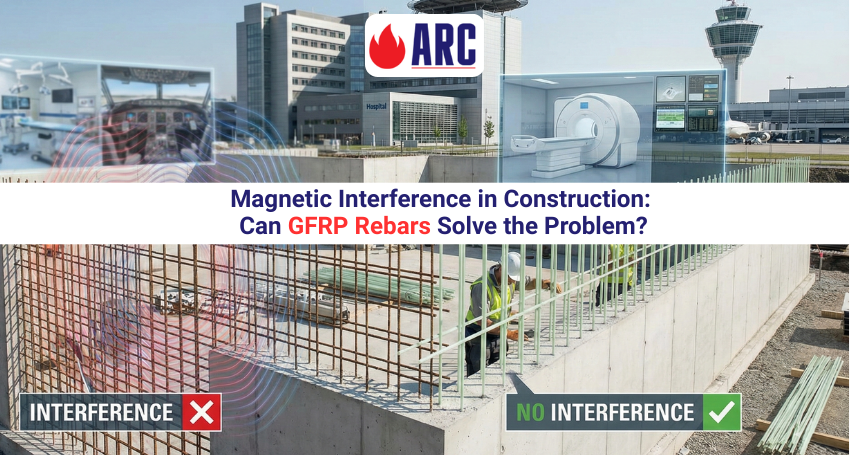
Magnetic interference is a serious concern in hospitals, airports, and research labs. These places need clean magnetic environments for MRI scanners and diagnostic equipment, navigation and communication systems, and work with ultra-sensitive instruments that can react even to small magnetic shifts. So, during the construction of these places, contractors can’t use steel, as it can […]

Nothing compares to strength and longevity in construction. This is why businesses are always looking for new ways to improve materials; one such innovation, glass fiber-reinforced polymer, or GFRP, is getting a lot of attention. By combining specialized glass fiber components with a robust resin matrix, this complex composite produces something truly remarkable. Rebars made […]