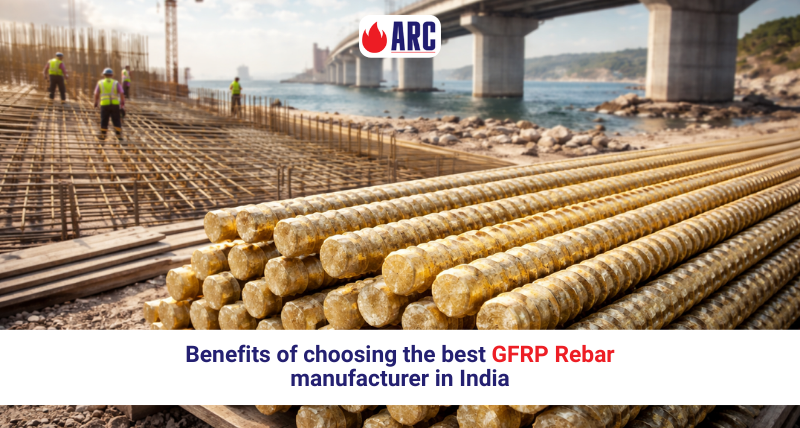
GFRP rebars are getting increasingly popular. The exclusive properties of these rebars are making them popular for foundation, precast, retaining wall, concrete road, drains and so on. However, you can’t just pick any supplier, you need the best GFRP rebar manufacturers in India for a peace of mind. In this article, we explore why picking the best manufacturer makes all the difference:
Here are a few reasons why you should consider working with established manufacturers:
GFRP rebar offers add immunity to corrosion. Unlike steel rebars that rusts when exposed to salt or moisture or chemicals, GFRP doesn’t corrode, making them usable for coastal, highway or industrial settings.
Opting for a reputable Indian manufacturer, one who follows standards like ACI‑440.1R and BIS 18256:2023, ensures your rebar meets stringent durability benchmarks. For instance, ARC Insulation and Insulators Ltd. offers in‑house testing across various diameters, building reliability into each batch.
GFRP rebars are a cost-effective material that also lower lifecycle costs. Since it doesn’t rust, it drastically cuts down maintenance. Therefore contactors or builders don’t have to spend on
GFRP rebar weighs up to 75 percent less than steel, making it light as a feather while still offering high tensile strength. Hence, it is easier to lift the materials with faster installation, and lower shipping costs.
Contractors can move GFRP bundles by hand on-site and place them more quickly than traditional steel cages, which can be more time-consuming. Reliable manufacturers produce straight bars or pre‑formed elements accurately, which make installation smoother and labour‑saving.
GFRP rebar excels in harsh conditions, under salt-laden coastal zones, near chemical plants, in wastewater facilities, or where road‑salt and humidity are a constant challenge.
The best GFRP manufacturers in India ensure corrosion-resilient products that maintain bond strength and structural integrity, whether for retaining walls, water tanks, piers, or bridges.
Plus, GFRP is non‑magnetic and non‑conductive, which makes it ideal for MRI rooms, high‑voltage infrastructure, labs, or power plant structures where steel rebar could interfere with sensitive equipment.
Sustainability is part and parcel of GFRP’s appeal:
Using FRP rebar supports LEED and other green‑building certification criteria around embodied carbon, resource efficiency, and durability.
Picking an Indian manufacturer certified for eco‑friendly practices ensures your project checks all sustainability boxes.
Although light, GFRP delivers excellent tensile strength-to-weight ratio, twice that of steel. That lets designers achieve structural integrity with less material. It also offers design flexibility!
Manufacturers supply straight bars, stirrups, or customized shapes to suit project specs, simplifying construction logistics. Engineers and architects can enjoy performance benefits without compromising form or function, especially in complex infrastructure or architectural usage.
Not all FRP rebars are created equal. Quality varies if producers skimp on raw materials, curing standards, or testing practices. A top-tier manufacturer ensures consistency via rigorous testing aligned with ACI‑440 and BIS norms.
At ARC Insulation and Insulators Ltd., we operate a controlled production line from straight to bent stirrups with internal quality labs. This minimizes variability in bond strength, tensile modulus, and compliance with engineering specifications.
Many reputed GFRP rebar manufacturers in India provide not only material but also technical backing, including:
Given the unique behavioral traits of GFRP, elastic linear failure, higher reinforcement ratios needed, custom anchorage, and special handling, a knowledgeable manufacturer can bridge the gap in design and execution.
The rebars can be pretty useful for India’s large infrastructure projects like seawall, and benefit a lot because ongoing salt damage and concrete spalling are minimized. A manufacturer with robust quality control ensures consistent composite strength and bond performance.
Choosing the best GFRP rebar manufacturer in India is more than a procurement decision. It’s a strategic choice that influences the longevity, sustainability, cost-efficiency, and structural performance of your project.
In India’s fast-growing infrastructure landscape, GFRP can be a robust and reliable solution. A reputable GFRP rebar manufacturer can offer game-changing advantages. Whether you’re crafting an eco-friendly development, a seaside structure, or a long-life industrial facility, the right GFRP provider ensures your building stands strong, stays sustainable, and saves on cost over decades.
GFRP (Glass Fiber Reinforced Polymer) rebar is a non-metallic reinforcement bar that doesn’t corrode like steel rebar. They are also lighter and nonmagnetic, making them suitable for harsh or sensitive environments.
A well-known Indian manufacturer offers region-specific expertise, BIS-certified products (e.g., BIS 18256:2023), and cost-effective logistics. They also provide technical support and pre-formed elements tailored for Indian infrastructure needs.
Yes, GFRP rebars are ideal for corrosive environments such as coastal zones, chemical plants, and wastewater facilities due to their non-corrosive and chemically inert nature.
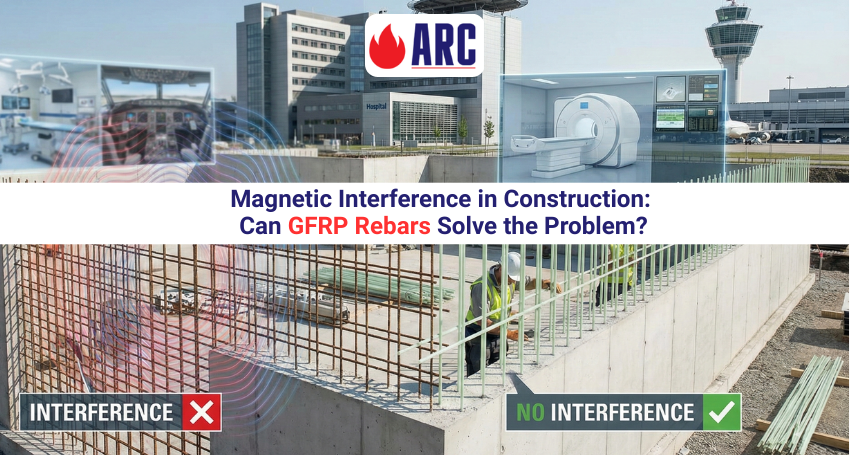
Magnetic interference is a serious concern in hospitals, airports, and research labs. These places need clean magnetic environments for MRI scanners and diagnostic equipment, navigation and communication systems, and work with ultra-sensitive instruments that can react even to small magnetic shifts. So, during the construction of these places, contractors can’t use steel, as it can […]

Every structure tells a story—a story of strength, endurance, and purpose. But behind that story lies something often unseen: reinforcement, the skeleton that holds everything together. For years, steel rebar has been the standard choice. But let’s face it—it’s not without flaws. Steel corrodes, weakens over time, and adds significant weight. That’s where ARC’s GFRP […]
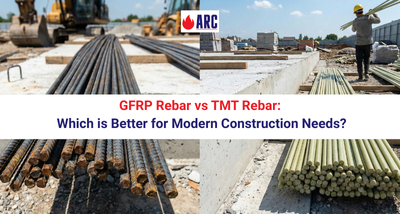
Strength and durability are the pillars of modern construction. The larger projects need the necessary strength to withstand the external force. When building structures, like a crash barrier, underground tank, boundary wall, grade slab, partition wall, reinforced bars or rebars are valuable. In India, both TMT (Thermo-Mechanically Treated) bars and GFRP (glass fiber reinforced polymer) […]