Monsoon can be complicated. Especially when the water management system is not designed for the season. Monsoon rains bring heavy downpours that test drainage systems. Floodwaters and waterlogging are common when streets and drains cannot keep up with the volume of rain. In saturated ground, even minor shifts can damage or misalign buried pipes. There are cases when the pipes broke, causing a disaster. Thus, it becomes essential to choose the right pipes. GRP pipes have become a popular choice for all year round.
But can they really withstand the monsoon rush? Let’s find out!
Glass-reinforced plastic (GRP) pipes, also called FRP (fiber-reinforced plastic), are designed for exactly these conditions. A GRP pipe is a composite of a plastic resin (often polyester or vinyl ester) reinforced by glass fibers. Manufacturing methods like filament winding produce a rigid, smooth pipe that is lightweight yet very strong.
Because the glass–resin matrix is chemically inert, these pipes resist rust and chemical attack. In fact, GRP/FRP pipes have been widely used in water supply and drainage systems in different industries. Their glass fiber reinforcement gives them tensile strength, while the resin coating protects against moisture and corrosive substances.
The rainy season requires special attention. Thus, it is essential that you choose pipes that require minimum maintenance, whether you are using them for seawater intake, storm water management, or spray pipe. Conventional pipes often fail under monsoon stress. Galvanized or steel pipes quickly rust when exposed to constant moisture. Clay or concrete pipes can crack if the ground shifts or if an unusually heavy load presses on saturated soil. GRP pipes offer exceptional performance in that regard.
Here are a few benefits of using these pipes:
GRP’s resin and glass construction offer resistance to various types of chemicals that cause corrosion, like acid, alkali, or salt. Monsoon stormwater often contains organic acids, road salt, or industrial pollutants. While other pipes may get impacted and cause leaking, GRP will not rust or pit like metal. This means years of leak-free service, even in cooling tower water treatments and sewage processes.
It is quite a natural phenomenon for a pipe to wear away. Abrasion resistance, on the other hand, describes the ability of a surface to avoid deterioration even during rubbing or friction. Floodwaters carry grit, sand, and debris that can erode pipes. The smooth inner surface of GRP prevents buildup and abrasion. Unlike rough concrete or rusty metal, a GRP drain pipe stays free-flowing. The “smooth inner wall” ensures low flow resistance, so drains can handle large volumes without clogging.
The heavy rainfall and humidity can damage materials and make them more hazardous. So, even when replacing a pipe, contractors look for something that is lightweight while also providing high strength.
GRP pipes have an excellent strength-to-weight ratio. They are easier to transport and install – an advantage in tight urban sites. The pipes put less stress on the supporting structure. Yet they still withstand heavy soil pressure and live loads.
The frictional losses in GRP are low. The combination of a straight, smooth bore and rigidity means GRP storm sewers maintain high flow even during heavy rains. In practice, this means better drainage capacity, which can cause floods or other serious hazards.
Monsoon can slow down maintenance. Once in place, GRP drains need very little upkeep. They never need rust-proof coatings or cathodic protection. The pipes are flexible, which also makes it comparatively easier to install them than traditional pipes. Over decades of monsoons, a GRP stormwater system remains largely maintenance-free.
Another advantage of GRP pipes is that you can customize them. Pipes are needed for various purposes, even during the monsoon. In some cases, your project may need a pipe with high wall thickness, while in other cases, one with a larger diameter might be more suitable. At ARC Insulation and Insulators Ltd., we provide GRP pipes with different diameters, wall thicknesses, and fittings.
GRP/FRP pipes offer a compelling solution for monsoon drainage. Their corrosion- and abrasion-resistant construction means stormwater and acidic rainwater cause minimal damage. Lightweight GRP sections make installation and joint alignment easier, even in flooded or difficult sites. Because GRP holds up through many rainy seasons without leaks, municipal planners and engineers can count on it for flood-prone areas.
At ARC Insulation and Insulators Ltd., our GRP pipes embody these advantages. When the monsoon hits, a properly engineered GRP system will channel the water away cleanly and reliably, unlike older materials that need constant repair.
Yes. GRP (Glass-Reinforced Plastic) pipes are ideal for monsoon conditions due to their corrosion resistance, smooth inner surface, and lightweight yet high-strength design. They resist waterlogging damage, chemical corrosion from stormwater, and abrasion from sand or debris.
No. GRP pipes are non-metallic and chemically inert, which basically implies that they do not rust or corrode, even when exposed to acid rain, road salt, or industrial runoff during the monsoon.
GRP pipes have a smooth inner surface and high hydraulic efficiency. This reduces friction losses and allows them to manage large volumes of water without clogging, making it perfect for flood-prone areas.
Yes. Unlike concrete, GRP pipes won’t crack due to ground shifting or water pressure. They also don’t rust like steel and are significantly lighter and easier to install.
Yes. GRP pipes have high load-bearing strength and flexibility, making them suitable for underground applications. They perform well even in saturated or shifting soil during heavy rains.
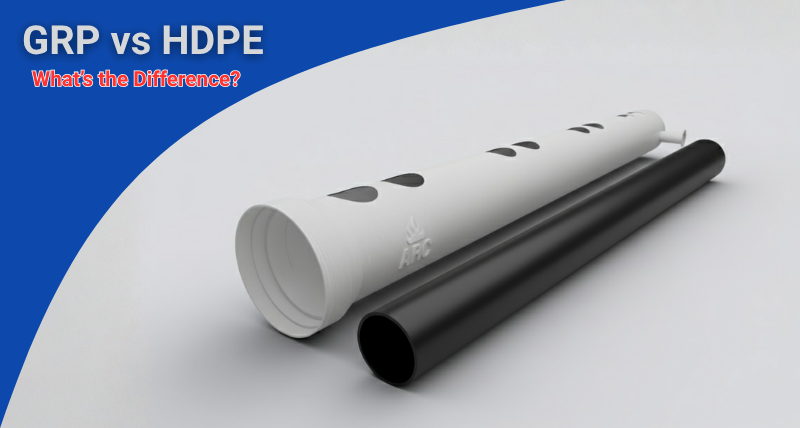
In infrastructure and industrial projects, each material holds a crucial position. Thus, it becomes essential to pay attention when choosing them, and piping material is no exception. Choosing the right pipe is critical for long-term performance, safety, and cost-efficiency. GRP (Glass Reinforced Plastic) pipes and HDPE (High-Density Polyethylene) pipes are some of the most popular […]