India's First BIS 18256 Certified GFRP Rebar Range


India's First BIS 18256 Certified GFRP Rebar Range

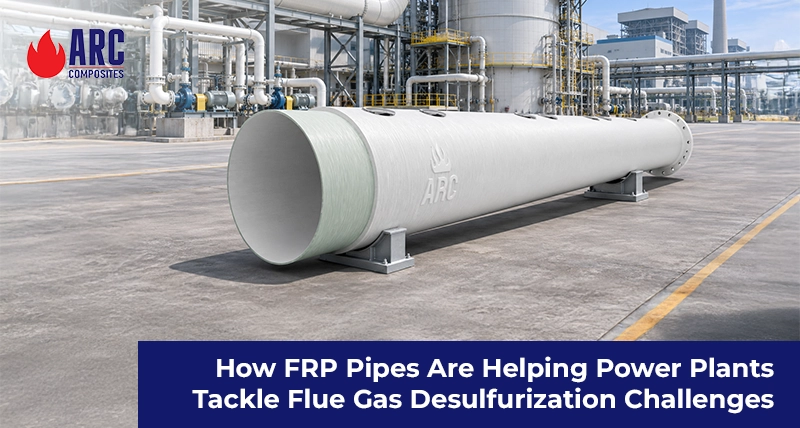
Every coal fired plant carries an unwelcome passenger in its exhaust. That passenger is sulphur dioxide, and flue gas desulfurization exists to evict it. The scrubber grabs all the glory, yet the pipes around it quietly decide whether the system runs or stalls. Limestone slurry scrapes. Gypsum slurry clogs. Acidic liquor eats unprotected metal for breakfast.
Choose the wrong material and you face leaks, unplanned shutdowns, and repair bills that ruin a good quarter. Plant engineers know this pain well, which explains why the FRP pipe now sits on so many FGD shortlists.
This guide walks you through chemical resistance, abrasion, operating temperature, internal surface finish, and maintenance needs. You will also see how engineers weigh these factors and what India’s 2026 compliance picture means for your next piping decision. Skip these details, and your expensive scrubber becomes a very costly paperweight. Read on, and you will finish with a practical selection checklist.
Coal contains sulphur. Burn the coal, and that sulphur leaves the boiler as sulphur dioxide. A wet scrubber catches it by spraying limestone slurry into the flue gas inside an absorber tower. The reaction forms gypsum slurry, which the plant dewaters and often sells. The process works beautifully, but only if the slurry piping survives.
Is flue gas desulfurization still required in India? Yes, though the rules now work in tiers. A July 2025 notification made FGD mandatory for plants within 10 km of the capital region or million plus cities, with a deadline of December 31, 2027. Plants near critically polluted areas face case by case review, with a default deadline of December 31, 2028. Remaining plants are exempt from the SO2 standard. A July 2026 analysis puts the exempted share at about 78 percent of coal fired units. The installed base is still huge. By August 2024, plants were installing FGD across 537 units, and 39 units totalling 19,430 MW had finished. Every one of those systems needs dependable piping for decades. Relaxed rules also do not shrink the pipe problem. They encourage plant owners to make smarter purchasing decisions and avoid duplicate expenses.
FGD lines work in one of the nastiest neighbourhoods in any power station. Two forces attack the pipe wall at once, and they rarely take turns.
Scrubber liquor stays acidic and carries chlorides. Plain carbon steel loses that fight quickly, and even some stainless grades struggle when chlorides and low pH join forces. Engineers therefore need strong chemical resistance across the full operating range, including upset conditions. A weak spot at a flange or bend becomes a leak, and a leak of acidic slurry is never a small problem. It damages supports, floors, and cables, and it invites a very unhappy safety meeting.
Slurry behaves like liquid sandpaper. Ground limestone and gypsum crystals race through recycle lines, and every bend takes a beating. Small diameter lines, such as absorber bleed pump systems, often see the highest velocities. An abrasion resistant liner protects the structural wall in those hot spots. Rubber linings handle particle velocities up to about 5 m/s, which gives designers a handy benchmark. Settling matters too. Slow flow lets solids drop out and block the line, so the design must balance wear against deposition.
A glass reinforced plastic pipe, also called a GRP pipe, combines a polymer matrix with glass fibre. Manufacturers build it through filament winding or contact moulding. Resin choice shapes performance. Epoxy vinyl ester resin leads in slurry service because it resists acids and chlorides well. With an abrasion resistant liner, this type of pipe has worked at more than 150 plant sites since 1977, and it remains the most common material for wet FGD slurry piping. That track record carries more weight than any brochure claim.
Temperature upsets also worry plant teams. Epoxy vinyl ester FRP can withstand upsets up to 600°F. FRP ductwork in FGD service tolerates excursions up to 315°C. The smooth bore keeps pressure drop low, so recycle pumps burn less energy. Typical FRP pipe has an operating pressure limit near 150 psi, which suits most low pressure scrubber lines.
Why is FRP pipe used in FGD systems? It resists corrosion without exotic alloys, it weighs far less than metal, and it costs less than nickel alloy options. Those three traits explain its long career in emissions control projects.
Every plant asks the same thing. Which pipe material is best for FGD slurry lines? The honest answer depends on pressure, temperature, and budget. This table keeps the comparison simple.
| Factor | FRP pipe | Rubber lined steel | Alloy steel |
| Corrosion resistance | Excellent with vinyl ester resin | Good while the lining stays intact | Strong, though chlorides can cause pitting |
| Abrasion handling | Good with a liner | Strong up to about 5 m/s | Depends on the grade |
| Weight | Light | Heavy | Heavy |
| Pressure and heat | Best for low pressure lines | Moderate duty | Best for high pressure and heat |
| Relative absorber cost | 1.00 baseline | About 1.22 | About 1.82 |
| Maintenance | Low | Lining repairs | Passivation after welding |
Published absorber cost comparisons rate rubber lined or acid brick lined carbon steel at 1.22 times FRP, and nickel alloy clad steel at 1.82 times. Those figures come from older studies, so treat them as relative indicators, not 2026 quotes. The direction still holds. FRP wins on weight and corrosion, rubber lining wins on abrasion at moderate speeds, and alloys win under heat and pressure. Smart plants mix materials line by line.
Selection starts with the slurry, not the catalogue. Engineers map every line by chemistry, solids, speed, and temperature before they choose a wall build. This checklist ensures the process remains transparent and fair.
• Chemical exposure. Confirm pH range, chloride level, and cleaning chemicals.
• Solids and velocity. Check particle size, solids percentage, and flow speed at bends.
• Temperature. Include upsets, not only normal operation.
• Pressure. Match pump head to the pipe rating with a safety margin.
• Internal surface. Prefer a smooth bore to limit scaling and pumping energy.
• Fire performance. Specify fire retardant resin where codes demand it.
• Joints and supports. Plan expansion, hangers, and nozzle loads early.
What should engineers check before choosing an FRP pipe for FGD? Ask the supplier for design basis data, liner details, and test certificates. Request references from similar slurry duty. Review how the manufacturer handles fittings, because bends and tees take the most abuse. Plan the inspection routine before day one. A pipe that looks cheap but fails at the first elbow was never cheap at all.
Maintenance decides the real price of any FRP pipe system. Low fouling and scaling mean fewer cleaning stops. Light weight cuts support steel and crane hours during installation. Small habits also help. Flushing lines with clean water during shutdowns prevents slurry from hardening, and stacking FRP pipes horizontally in storage prevents deformation.
Time pressure raises the stakes. Vendor capacity sits near 16 to 20 GW per year, and one unit takes about 44 to 48 months to install. India has also lifted local manufacturing of FGD components from 70 to 80 percent. Delay carries a price. Non compliant plants that do not retire face graded environmental compensation of up to Rs 0.40 per unit generated. Meanwhile, plants that installed FGD despite the 2025 relaxation face higher generation costs and may lose out in dispatch. Those plants require production lines with low operating costs.
How long does an FRP pipe last in FGD service? Case histories now span decades, and published design data for FRP pipe often uses a 50 year hydrostatic strength basis. Good specification and routine liner checks protect that life.
Flue gas desulfurization remains a core part of cleaner coal power, even after India’s 2025 tiered rules. Category A plants must install scrubbers, Category B plants face case by case review, and thousands of megawatts of existing FGD capacity still need reliable piping. The pipes carry acidic, abrasive slurry every hour of every day.
That reality makes chemical resistance, abrasion control, temperature tolerance, a smooth bore, and low maintenance the five factors that matter most. FRP pipe meets those needs through resin choice, liners, and smart design. It does not beat every material in every duty. Rubber lined steel handles abrasion well, and alloys suit high heat and pressure.
Yet for most low pressure slurry lines, FRP delivers a strong mix of durability, low weight, and lifecycle savings. Use the selection checklist, ask hard questions of suppliers, and plan maintenance early. Your scrubber will then spend its days removing sulphur dioxide, not leaking onto the floor.
Your scrubber deserves pipes that last longer than the next budget cycle. ARC Composites makes FRP pipe and GRP pipe through contact moulding and filament winding. The range uses E glass reinforcement and resin systems such as thermosetting polyester, epoxy, and phenolic. Because FRP resists corrosion, you can eliminate internal lining, external coating, and cathodic protection. The pipes arrive in a wide range of diameters, and the team can tailor wall thickness, fittings, and joining methods to your line.
The published design basis lists an ultimate hoop stress of 250 N/mm2 and a long term hydrostatic strength of 172 N/mm2 over 50 years. The smooth interior reduces friction and pressure drop, so your pumps work less. Low fouling and light weight cut maintenance and installation effort. FGD system plants appear among the listed applications, and the pipes come with in house and independent third party test certificates.
Ready to specify? Share your slurry data, diameters, and pressure needs. Email info@arcinsulations.com or call +91 97487 08809, and the ARC Composites team will help you choose the right pipe for your FGD project.
An FRP pipe carries limestone slurry, gypsum slurry, and process water between absorbers, pumps, and tanks. It resists acidic liquor and chlorides, which attack carbon steel and many stainless grades quickly.
Yes, when engineers add an abrasion resistant liner and control flow velocity. The liner protects the structural wall at bends and small diameter lines where wear concentrates.
Published absorber comparisons rate rubber lined steel about 22 percent above FRP. Actual prices vary by project, so request current quotes and compare total lifecycle cost, not purchase price alone.
Its resistance to corrosion eliminates the need for protective coatings and cathodic protection. The smooth bore limits scaling and deposits, so crews clean less often and inspect mainly liners, joints, and supports.
Epoxy vinyl ester resin leads for slurry piping because it resists acids, chlorides, and temperature upsets. Fire retardant grades suit locations where codes demand added fire protection.