India's First BIS 18256 Certified GFRP Rebar Range


India's First BIS 18256 Certified GFRP Rebar Range

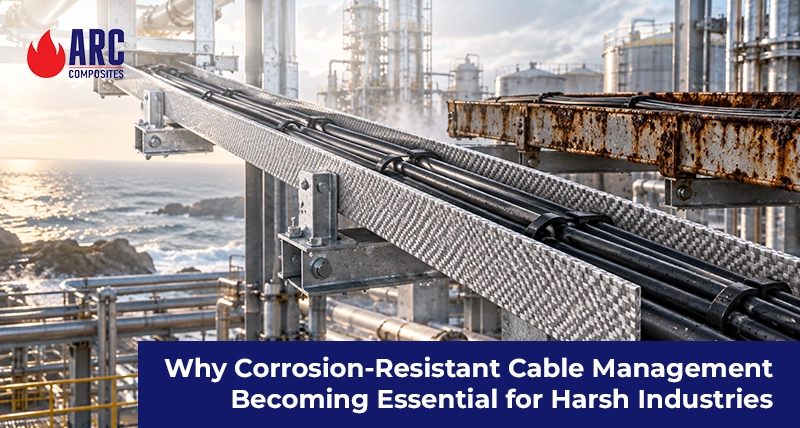
A cable tray hanging quietly overhead rarely gets a second thought until something goes wrong. Then suddenly everyone is asking how a support system that looked fine last year is now rusted through, sagging, or worse, failing under the weight of the cables it was supposed to protect. Facilities operating in chemical plants, power generation sites, and coastal industrial zones know this frustration intimately.
Steel cable trays exposed to moisture, chemical fumes, and atmospheric pollutants degrade far faster than most maintenance schedules account for, and by the time corrosion becomes visible, the structural damage is often already significant.
This blog examines why FRP cable tray systems have become essential infrastructure for harsh industrial environments, exploring exactly how corrosion attacks traditional cable support systems, why maintenance access becomes genuinely difficult once degradation sets in, and how composite materials solve this problem at its root rather than simply delaying the inevitable.
Corrosion rarely announces itself immediately, and understanding how it progresses inside industrial facilities explains why cable trays fail more often than most maintenance teams expect.
Steel and galvanized cable trays begin degrading the moment they encounter moisture, chemical vapours, or airborne pollutants common in industrial atmospheres. Facility managers frequently ask, ‘Why do cable trays corrode faster in industrial environments?’ and the answer involves a combination of factors working simultaneously. Humidity accelerates oxidation, chemical fumes attack protective galvanized coatings, and airborne particulates from processing operations settle onto tray surfaces, creating localized corrosion cells that eat through metal from small points outward. This process often starts on the underside or interior surfaces of the tray, areas rarely inspected during routine walkthroughs, which means corrosion can progress significantly before anyone notices a visible problem.
Once corrosion weakens a cable tray’s structural sections, the tray’s actual load-bearing capacity drops below its original rating, even though the tray may still look serviceable from a distance. This creates a genuinely dangerous gap between assumed capacity and actual capacity, particularly in facilities where additional cables get added to existing trays over the years without reassessing the support system’s remaining strength. A tray rated for a certain cable load when installed may no longer safely carry that same load after years of corrosion-related section loss, and this risk compounds in facilities that rarely schedule structural inspections for what most people consider passive infrastructure.
Cable trays often sit in locations that made perfect sense during original installation but become genuinely difficult to access once a facility has been operating for years.
Industrial facilities frequently route cable trays overhead, through congested equipment areas, or alongside process piping where physical access requires scaffolding, lifts, or confined space protocols. Maintenance teams often want to know how much corroded cable tray replacement typically costs, and while exact figures vary significantly by facility size and access difficulty, the honest answer is that labour and access costs frequently exceed the material cost of the tray itself once scaffolding, shutdown coordination, and confined space safety measures enter the equation. Replacing a corroded steel tray in a hard-to-reach location can require partial facility shutdown, temporary cable rerouting, and coordination across multiple departments, turning what should be a straightforward repair into a significant operational disruption.
Facilities that defer cable tray maintenance because access is difficult often find that the eventual repair becomes more extensive and expensive than it would have been if addressed earlier. Corrosion that could have been managed with a protective coating in its early stages often progresses to the point where the tray section requires full replacement, along with the cables it supports if physical damage has occurred. This deferred maintenance pattern is exactly why corrosion resistance built into the material itself, rather than relying on protective coatings that need periodic reapplication, offers such a meaningful operational advantage for facilities with genuinely difficult access conditions.
Rather than managing corrosion through coatings and inspection schedules, composite cable trays remove the underlying vulnerability entirely.
FRP cable trays are manufactured from fiber reinforced polymer, a material that simply does not oxidize or corrode the way steel does, regardless of humidity, chemical exposure, or atmospheric pollutant concentration. Facility engineers evaluating alternatives often ask do FRP cable trays perform better than steel in chemical environments, and the material science behind that question is fairly direct. Because there is no metal content within a FRP tray’s structure, the corrosion cells that form on steel surfaces through moisture and chemical exposure simply cannot develop in composite trays, removing the entire degradation mechanism rather than slowing it down through surface treatment.
Chemical resistance in FRP cable trays extends beyond simple moisture protection to include resistance against acidic fumes, alkaline exposure, and solvent vapours common in chemical processing facilities. This resistance comes from the resin formulation used in manufacturing, which can be selected specifically based on the chemical environment the tray will operate within, similar to how resin selection works for other FRP industrial products. Power generation facilities, chemical processing plants, and pulp and paper operations all present distinct chemical exposure profiles, and properly specified FRP trays account for these differences rather than applying a single generic material solution across every application.
Corrosion resistance gets most of the attention, but the practical handling characteristics of composite cable trays deliver real operational value during both installation and ongoing facility work.
FRP cable trays weigh considerably less than comparable steel trays, which translates directly into faster installation, reduced need for heavy lifting equipment, and lower physical strain on installation crews working in overhead or awkward positions. This weight advantage matters particularly during retrofit projects, where installation crews often work within existing congested spaces that make manoeuvring heavy steel sections genuinely difficult. Lighter composite trays allow single- or two-person installation in situations that might otherwise require additional crew members or mechanical lifting assistance, reducing both project timeline and labour costs.
Beyond installation convenience, the reduced weight of FRP trays lowers the load placed on supporting structures, brackets, and building infrastructure that the cable tray system attaches to. This matters significantly in retrofit scenarios where existing structural supports were engineered for specific load limits, since replacing heavy steel trays with lighter composite alternatives can sometimes avoid the need for supplementary structural reinforcement that a like-for-like steel replacement might otherwise require. Facilities planning long-term cable infrastructure upgrades increasingly factor this structural load advantage into their material selection process, particularly across multi-level facilities where cumulative tray weight across many runs adds up considerably.
The real value of corrosion-resistant cable management becomes clearest when viewed across a facility’s full operational lifecycle rather than just initial installation cost.
Cable tray failures rarely happen in isolation. A collapsed or severely corroded tray section can damage the cables it was supporting, potentially causing unplanned outages, safety incidents, or costly emergency repairs that disrupt production schedules. FRP cable trays significantly reduce this failure risk by removing the corrosion mechanism that causes most tray degradation in harsh industrial settings, allowing facilities to plan maintenance proactively rather than reactively responding to unexpected structural failures. This reliability improvement matters enormously in continuous process industries, where unplanned shutdowns carry substantial production and revenue impact beyond the direct repair cost.
Service life extension is where composite cable tray investment genuinely pays off over time. While FRP trays may carry a different upfront cost profile compared to standard steel options, the elimination of corrosion-related replacement cycles, reduced coating maintenance, and lower failure-related disruption costs typically produce meaningfully lower total cost of ownership across a multi-decade facility lifespan. Facilities in chemical processing and power generation sectors, where cable infrastructure often needs to last as long as the surrounding plant itself, increasingly recognize that material durability decisions made during initial design or retrofit planning directly shape decades of subsequent maintenance budgets and operational reliability.
Corrosion-resistant cable management has moved from a nice-to-have upgrade into a genuine operational necessity for facilities operating in harsh industrial environments. Steel cable trays quietly degrade under moisture, chemical exposure, and atmospheric pollutants, often reaching structural weakness long before visible corrosion signals a problem.
FRP cable tray systems solve this at the material level, eliminating the corrosion mechanism entirely while delivering lighter weight, easier installation, and meaningfully longer service life across chemical processing, power generation, and other demanding industrial applications.
Facilities that factor in maintenance access difficulty, deferred repair costs, and total lifecycle expense increasingly find that composite cable trays deliver genuine long-term reliability that traditional steel infrastructure simply cannot match.
Their glass fiber-reinforced polymer construction contains no metal, so the oxidation and corrosion process that degrades steel simply cannot occur in composite trays.
Yes, resin formulations can be selected for specific chemical exposure, providing resistance against acidic fumes, alkaline exposure, and solvent vapours common in chemical plants.
Pricing varies by project, but lower long-term maintenance, no corrosion-related replacement, and reduced installation labour often offset any initial cost difference.
Lighter FRP trays require less lifting equipment, reduce structural load on supports, and allow faster installation, especially in congested or overhead locations.
Yes, since corrosion-related structural failure is eliminated, facilities experience fewer unexpected tray failures that could otherwise damage cables and disrupt operations.