India's First BIS 18256 Certified GFRP Rebar Range


India's First BIS 18256 Certified GFRP Rebar Range

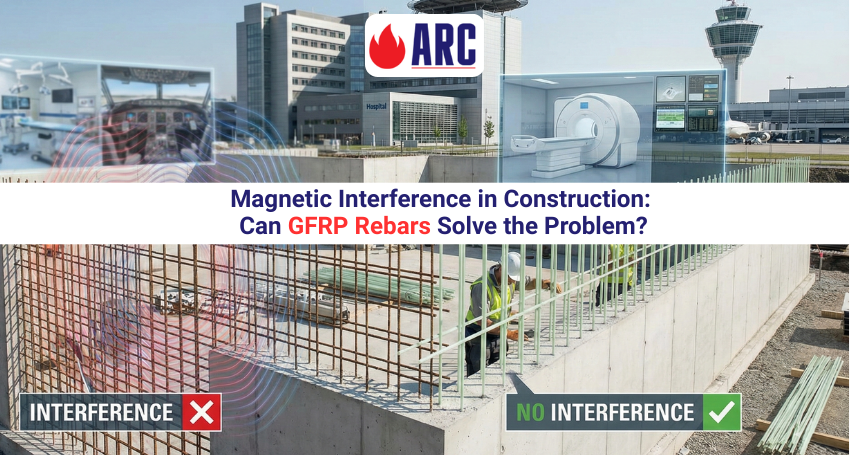
Magnetic interference is a serious concern in hospitals, airports, and research labs. These places need clean magnetic environments for MRI scanners and diagnostic equipment, navigation and communication systems, and work with ultra-sensitive instruments that can react even to small magnetic shifts.
So, during the construction of these places, contractors can’t use steel, as it can affect performance, safety, or data reliability. That’s why engineers are now studying alternatives like glass fiber reinforced polymer rebar that don’t disturb magnetic fields.
In this article, we will be discussing magnetic interference in construction and how GFRP rebars can help tackle it:
Electromagnetic interference (EMI) refers to unwanted magnetic fields from materials or equipment. These fields can influence sensitive electronics and sensors like communication systems, navigation equipment, MRI and cause them to malfunction. Any ferrous metal in a structure can generate stray fields or currents. In construction, using steel reinforcement bars causes such interference. This is one of the reasons why in MRI suite planning guidelines explicitly advise using fiberglass‐reinforced concrete instead of steel. GFRP rebar preserves magnetic field homogeneity, so the instruments and sensors can function smoothly.
Like we mentioned before, magnetic interference can influence different industries, including:
MRI rooms and quantum-lab clean rooms can’t compromise with magnetic interference. They require near-zero magnetic distortion. Hence, construction guidelines forbid steel reinforcement within the MRI safety zone. Quantum research centers even build entire slabs and tables with glass-fiber composite rebar to achieve electromagnetic isolation.
Steel in concrete can interfere with
This can create serious problems in runways, taxiways, and terminals that have extensive navigation and communication gear.
Roadways and tollbooths often use inductive loop sensors to detect vehicles. Fiberglass rebars are used near these systems so as not to distort the inductive fields. Traditional steel bars can reduce loop sensitivity and accuracy.
High-voltage equipment and transformers generate strong fields. Steel in nearby concrete structures can interact with these fields, so non-magnetic rebars are preferred. Composite rebars are listed for use in electrical environments (e.g., substations) where EMI must be controlled.
Underground trains and metros have strict EMI limits for signaling. Glass fiber reinforced polymer rebars have zero magnetic permeability, so they won’t induce currents in catenaries or distort onboard sensors.
Certain chemical plants, refineries, and offshore platforms have sensitive automation. Using non-metallic reinforcement avoids introducing stray fields that could interfere with control electronics.
While Steel rebars have a long-term reputation for adding stability, they are not the best in terms of EMI. These rebars often cause:
Steel is ferromagnetic and conducts electricity. Hence, it creates and carries magnetic fields under load or near current. This means a reinforced wall or slab can act like part of an antenna or circuit, inducing interference in nearby devices. For example, steel bars can slightly shift a magnetic resonance image or detune sensitive radar.
Steel starts to rust when it comes in contact with saltwater and chemicals. Corrosion also causes their electromagnetic properties to change over time. Corroded steel can create unpredictable magnetic hotspots or shifts in bulk properties. This complicates any efforts to model or shield against interference.
While heavy steel offers high strength, it also makes handling harder. This means you need more conductive cables and support gear. All of this ends up increasing the complexity of the project.
Glass-Fiber Reinforced Polymer (GFRP) rebars are specifically engineered to deal with these problems.
The polymer matrix and glass fibers in GFRP have no free electrons or magnetic domains. GFRP rebar is a safe alternative that avoids conductivity and magnetic interference. Engineers have even observed that these bars are neither electrically conductive nor magnetizable, enabling electromagnetic decoupling of structural elements. This is often phrased as electromagnetic transparency – GFRP simply lets fields pass as if the reinforcement weren’t there.
Unlike steel, GFRP does not rust or react with salts and chemicals. This means the bar’s properties remain constant over decades, so its non-magnetic nature stays reliable. Long-term studies show GFRP structures can last 80–100+ years in harsh conditions, far outliving conventional steel.
GFRP bars have tensile strengths often 2x that of steel but weigh 7x lighter in concrete flatwork applications. Their lightweight means easier transport and handling – crews can carry them by hand and install with minimal equipment. This not only cuts costs but also reduces embedded metal needed for supports, for example, cranes, which might themselves cause stray fields if electric.
GFRP rebars can be made in custom shapes and sizes (straight, bent, mesh) to match project needs. Although they must be prefabricated, their consistency reduces onsite cutting and bending – meaning the as-built reinforcement matches design predictions exactly. Unlike rebar that is bent which can change magnetic grain structure in steel, GFRP shapes do not alter their material properties, keeping them predictably inert.
Over a structure’s life, GFRP reinforcement needs virtually no upkeep, like painting or cathodic protection. This reliability is crucial for applications where access is limited, such as offshore platforms and bridge decks. It also means the interference profile won’t change due to rust or fatigue cracks.
Magnetic interference is a critical concern in many modern construction projects, from hospitals and airports to tunnels and power plants. Traditional steel reinforcement, while strong, is inherently magnetic and conductive, which can disrupt sensors, communications, and precision equipment. GFRP rebars provide a straightforward solution. They are non-magnetic, non-conductive, and durable, meaning they literally eliminate the interference problem.
Yes. In spaces like MRI rooms, airports, clean labs, and toll systems, even small magnetic disturbances can affect readings, signals, and sensor accuracy. When steel is used inside structural concrete, it quietly becomes a source of interference.
Not always. Standard buildings, warehouses, or low-tech structures can safely use steel. GFRP becomes important mainly in projects where signal accuracy, electromagnetic stability, or sensitive instruments are part of the environment.
GFRP rebars can sometimes cost more upfront than steel, but they cut long-term expenses by preventing corrosion, reducing maintenance, and avoiding equipment-related issues caused by magnetic interference. For environments with high EMI sensitivity, they can actually reduce total project cost.
It won’t remove interference from external equipment or wiring, but it eliminates the rebar as a source, which is often the biggest hidden contributor inside a building’s structure.

Nothing compares to strength and longevity in construction. This is why businesses are always looking for new ways to improve materials; one such innovation, glass fiber-reinforced polymer, or GFRP, is getting a lot of attention. By combining specialized glass fiber components with a robust resin matrix, this complex composite produces something truly remarkable. Rebars made […]

Every structure tells a story—a story of strength, endurance, and purpose. But behind that story lies something often unseen: reinforcement, the skeleton that holds everything together. For years, steel rebar has been the standard choice. But let’s face it—it’s not without flaws. Steel corrodes, weakens over time, and adds significant weight. That’s where ARC’s GFRP […]

GFRP rebars are getting increasingly popular. The exclusive properties of these rebars are making them popular for foundation, precast, retaining wall, concrete road, drains and so on. However, you can’t just pick any supplier, you need the best GFRP rebar manufacturers in India for a peace of mind. In this article, we explore why picking […]